Stock Fencing in Nottingham
Stock fencing in Nottingham — strained wire stock netting for sheep, cattle, horses, and smallholdings, with barbed or plain top wire. Free visits.
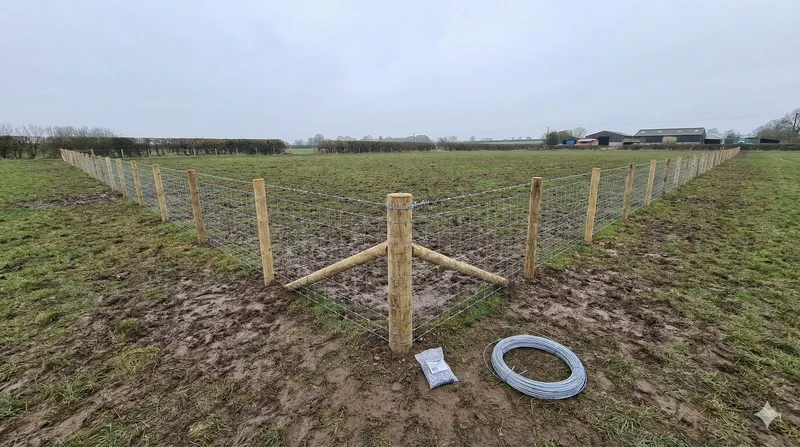
Expert Stock Fencing Services
Stock fencing is the practical, cost-effective way to contain livestock and divide land over distance. Galvanised stock netting (pig netting) strained tight between posts gives a strong, long-lasting boundary that keeps sheep, cattle, and other animals where they should be, while standing up to the weather and the rubbing and leaning that livestock give a fence. It's the standard agricultural and smallholding boundary across rural Nottinghamshire.
K.A.B Fencing installs stock fencing throughout Nottingham and the surrounding rural areas for farms, smallholdings, paddocks, and equestrian use. The job is in the straining: properly set, braced straining posts at ends, corners, and intervals, with the netting and line wires stretched tight so the fence stays taut and stockproof for years. We match the netting type to the animals being contained and can add a plain or barbed top wire, and we'll walk the line with you at a free site visit before quoting.
Why Choose Our Stock Fencing?
Quality Materials
Premium timber and materials built to last
Expert Installation
Skilled craftsmen with years of experience
Competitive Pricing
Fair quotes with no hidden costs
Guaranteed Work
Full warranty on all installations
Stock netting matched to the animals
Stock netting comes in different heights and mesh patterns for different livestock — the vertical and horizontal wire spacing is graduated so it's tighter near the ground (to stop lambs and smaller animals pushing through) and the overall height suits the stock. Sheep and lambs need a tighter, lower netting; cattle need a taller, heavier-gauge net that takes leaning and rubbing; mixed or smallholding use sits in between. We specify the right net for what you're keeping so the fence actually holds the stock rather than being a generic compromise.
Posts, straining, and bracing
A stock fence lives or dies on its straining. We set substantial straining posts — properly braced with struts or anchored — in the ground at every end, corner, and change of direction, and at intervals along long runs, then strain the line wires and netting tight against them with intermediate stakes supporting the run. Livestock test a fence constantly, so a baggy, under-strained stock fence fails fast. Done properly, the netting stays drum-tight and the line holds for years. We use treated timber posts rated for in-ground agricultural use.
Top wire — plain or barbed
Most stock fences carry a top line wire above the netting to add height and discourage animals from leaning or reaching over. This can be plain wire (for horses and where barbed isn't wanted — barbed wire and horses don't mix) or barbed wire (common for cattle and sheep boundaries to stop rubbing and pushing). We'll advise based on the stock: paddock and equestrian fencing avoids barbed for safety, while a cattle boundary often benefits from it. A line or two of plain wire below the net can also be added on rougher ground.
Equestrian and paddock fencing
For horses, safety drives the spec. Plain top wire (never barbed near horses), netting with a mesh that won't trap a hoof, and often a timber top rail for visibility and to stop horses leaning are the usual combination — which is where stock fencing and post-and-rail overlap. We frequently combine stock netting with a post-and-rail top for paddocks: the rail gives the horse a clear, safe boundary line and the netting underneath keeps smaller animals and foals contained. We'll talk through the right combination for your paddock.
Gates and access
Field and paddock access needs gates that suit livestock and machinery — galvanised steel field gates in widths to take tractors, trailers, and stock movements, hung on properly set, braced gateposts that take the weight without dropping. We supply and hang field gates and pedestrian access gates to match the fence line, with stock-proof latches. A well-hung field gate that swings true and latches reliably is part of a fence that actually contains stock.
Why Nottinghamshire landowners choose K.A.B for stock fencing
We're a Nottingham-registered limited company trading from Chris Allsop Industrial Park in Colwick, with over 140 five-star reviews on Google. Owner-led — Kye runs every job. Free no-obligation site visits, fixed prices in writing before work starts, all work guaranteed. We install stock fencing, post-and-rail, field gates, and the full fencing range across Nottingham and rural Nottinghamshire, so paddocks and boundaries can be specified exactly for the stock and the ground. Ring us to walk the line and get a quote.
Areas We Cover
View All Areas →Frequently asked questions
What is stock fencing?
What livestock can stock fencing contain?
Should I use barbed or plain top wire?
Can you combine stock fencing with post-and-rail for horses?
Why does stock fencing sometimes go saggy?
Do you install stock fencing across rural Nottinghamshire?
Related Fencing Services

Heavy-Duty Feather Edge Fencing
Heavy-duty feather edge fencing in Nottingham — bespoke panel construction, kiln-dried treated boards, traditional looks that age beautifully. Free quote.
Learn More
Heavy-Duty Closeboard Fencing
Heavy-duty closeboard fencing across Nottinghamshire — concrete posts, gravel boards, feather-edge panels. Built to outlast timber-post fences. Free quote.
Learn More
Composite Fencing Installation
Composite fencing in Nottingham — rot-free, low-maintenance panels in stone grey, charcoal, and natural wood finishes. Free quotes.
Learn MoreReady to Start Your Project?
Contact us today for a free consultation and quote. We serve Nottingham and all surrounding areas.