Concrete Post Spur Repair in Nottingham
Concrete post spur repair across Nottinghamshire — bolt a reinforcing spur to a snapped or cracked concrete post without taking the panels down. Free quote.
Expert Concrete Post Spur Repair Services
Concrete fence posts fail in a particular way. They don't rot, but they crack and snap — usually at ground level, where soil moisture and freeze-thaw cycles concentrate stress against an unsupported part of the post, or higher up after vehicle impact has weakened the structure. A snapped concrete post brings a section of fence out of alignment; left alone, the lean worsens until the boards come away or the run goes down entirely. Full replacement of a concrete post means dropping the panels either side, breaking out the old foundation, setting a new post in fresh concrete, and refitting the panels — disruptive, time-consuming, and on weathered feather-edge or closeboard runs it risks damaging the existing boards in the handling.
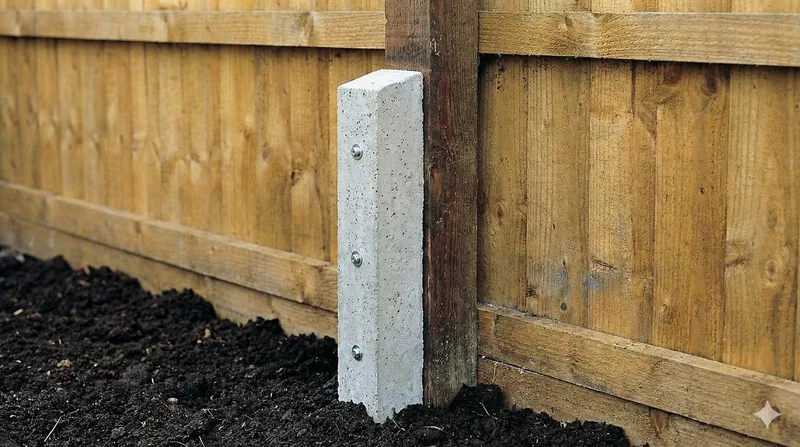
A concrete spur is the cheaper, less invasive answer for most ground-level failures. The technique: dig a new foundation alongside the damaged post (no need to remove the original), set a short reinforced-concrete spur — typically 600–900mm long — into fresh concrete with its top section reaching up next to the failing post, then bolt the spur through to the old post with galvanised through-bolts. The spur becomes the structural support; the original post is held upright but no longer load-bearing. The fence panels stay in their slots throughout — no boards dropped, no rails refitted, no risk to the existing run. We use this technique routinely across Nottingham and Nottinghamshire on concrete-post fence runs where one or two posts have failed but the rest of the boundary is sound.
Why Choose Our Concrete Post Spur Repair?
Quality Materials
Premium timber and materials built to last
Expert Installation
Skilled craftsmen with years of experience
Competitive Pricing
Fair quotes with no hidden costs
Guaranteed Work
Full warranty on all installations
What a concrete post spur actually is
A concrete post spur is a short reinforced-concrete (or sometimes steel) post-section — typically 600–900mm long — designed to be bolted alongside a failing concrete fence post and concreted into a new foundation. It's narrower and lighter than a full fence post (it doesn't need to span the whole panel height), but it carries the same load profile from the ground up. Once installed, the spur is what holds the fence panels upright; the original post is essentially decorative at that point, held in place by the bolts but no longer doing structural work. Concrete spurs are the standard product across UK fencing merchants; steel spurs are also available and work the same way but are used less often on domestic boundaries.
Why concrete posts fail at ground level
Concrete fence posts are extremely durable — they outlast the timber components around them by decades — but they're not indestructible. The most common failure mode is a clean snap or crack at or just below the ground line, where soil moisture, freeze-thaw cycles, and ground heave concentrate stress against the post body. Other failure modes we see across Nottinghamshire: vehicle impact (a reversing van clipping a post), root damage from a nearby tree pushing on the foundation, original installation faults (foundation set too shallow, concrete cured against the post body and cracked as the post moved), and simple age on posts that have been in the ground 30+ years. Each of these is a candidate for a spur repair rather than full replacement, provided the post above the failure point is still structurally sound.
The install — excavate, position, bolt, concrete
Spur installation runs in roughly five steps. First, expose the failing post at ground level — dig back the soil around the base to find the break and assess the damage. Second, dig a new foundation hole tight against the original post, sized to accept the spur and its concrete collar (typically 600mm deep, 200–250mm diameter on a domestic boundary; larger for taller fences or exposed sites). Third, position the spur upright against the failing post with its top section reaching as high as the rails or panel-fixing height allows. Fourth, drill through both spur and old post and run galvanised through-bolts to fix them together — usually two bolts at different heights for proper load transfer. Fifth, fill the foundation hole with post-mix concrete and let it cure. The fence run stays in place throughout; we work around the existing panels rather than dropping them.
Why the panels stay in place — the key advantage
This is the reason most clients choose a spur over a full replacement. A full post swap requires the panels either side of the failing post to come out of their slots so the post can be lifted; on feather-edge or closeboard runs that means dismantling boards individually, with a real risk of damaging the existing timber in the process. A spur repair avoids all of that. The new foundation hole goes alongside the failing post, not where the post sits; the spur is installed without disturbing the slots or the rails; the panels either side of the post stay in their existing positions throughout the job. For long runs of mature feather-edge or closeboard where the boards have weathered into a uniform finish, that's a significant advantage — fixing one post shouldn't mean ageing-mismatched boards in the rebuild.
Spur versus full post replacement — when to choose which
A spur is the right call when the concrete post has failed at ground level but the post body above the break is still sound, and when the surrounding fence (rails, boards, gravel boards, fixings) is in serviceable condition. Full post replacement is the right call when: the post has snapped above the rail-fixing height (no top section left to bolt the spur to); the post has failed in multiple places along its length; the surrounding components are also at end-of-life and would need replacing anyway; or impact damage has compromised the panel slots themselves. We'll diagnose at the site visit which is appropriate and explain in writing before any work starts. Sometimes a spur is the right call on one post and full replacement is right on another along the same run.
Why spurs don't work on every broken post
Spur repair has limits. The technique relies on the original post being structurally sound from the break point upward — if there's a second crack higher up, the spur can't span both failures. The panel slots in the original post need to be intact so the boards can keep sitting in them; vehicle impact damage that's cracked the post body along its length usually compromises the slots. And spurs add a visible second post-section at ground level next to the original; on a feature boundary where the look matters, some clients prefer a clean full replacement. We'll be straight at the assessment when a spur isn't appropriate — and why.
Multiple broken posts — when to escalate to full replacement
When several posts on the same run have failed, the spur-versus-replace calculation changes. One or two failures on a long boundary? Spurs are usually cheaper and faster than full replacement, with no impact on the rest of the fence. Five or more failures on a single run, though, suggests the boundary is broadly aging out — typically 25+ years on the original install — and like-for-like spur repair on every failed post is buying you only a year or two before the next one fails. At that scale we'll usually recommend full fence replacement with new concrete posts and gravel boards as the more durable answer. Stepped repair plans across two seasons sometimes work out cheaper than repeated callouts on an end-of-life boundary.
Spurs and timber posts — a different repair pattern
Concrete spurs are designed to pair with concrete posts. Failing timber posts have their own repair pattern, usually full timber-post replacement. In some cases a timber-on-timber sister repair (a treated-timber section bolted alongside the failing post) is possible and works on the same structural principle, but it's less common because timber posts that have failed at ground level are usually past the point where saving them makes economic sense — easier and more durable to fit a new UC4-treated post. We'll recommend the right repair pattern for the specific post type and condition at the site visit, in writing, before any work starts.
Why Nottingham customers call K.A.B for spur repairs — and what it costs
We're a Nottingham-registered limited company trading from Chris Allsop Industrial Park in Colwick, with over 140 five-star reviews on Google. Owner-led — Kye runs every job from quote through to fitting. Free no-obligation quotes, fixed prices in writing before work starts, all repairs guaranteed. Concrete spur repair is one of the most common interventions we do on long concrete-post fence runs across the area — often a same-visit fix on a single-post job, and typically priced well below a full concrete-post replacement (cheaper materials, no panel handling, no waste timber to remove). Site visit usually within a week of enquiry. Final cost depends on whether the old foundation needs significant breakout, how accessible the post is, and whether anything else needs addressing while we're on site.
Request a Quote
Get a free, no-obligation quote for your concrete post spur repair project.
Get Quote Call NowAreas We Cover
View All Areas →Frequently asked questions
What is a concrete post spur?
When should I use a spur instead of replacing the whole post?
Will my fence panels need to come down for a spur repair?
How long does a concrete spur repair last?
Is a spur repair cheaper than a full concrete-post replacement?
Can you fit a concrete spur to a timber post?
How long does a spur installation take?
What if more than one concrete post is broken on the same run?
Related Fencing Services

Emergency Fencing Repair
Emergency fencing repair across Nottinghamshire — vandalism, vehicle impact, accidental damage, and security breaches. Call to make the boundary safe.
Learn More Storm-Damaged Fence Repair
Storm-damaged fence repair across Nottinghamshire — fast callout for lifted panels, snapped posts, and flattened runs. Call to make the boundary safe.
Learn More
Fence Post Replacement & Repair
Fence post replacement across Nottinghamshire — rotted, snapped, or leaning posts swapped without dropping the whole fence run. Free quote today.
Learn MoreReady to Start Your Project?
Contact us today for a free consultation and quote. We serve Nottingham and all surrounding areas.