Heavy-Duty Post & Rail Fencing in Nottingham
Heavy-duty post and rail fencing across Nottinghamshire for paddocks, smallholdings and commercial perimeters. 2, 3, and 4-rail. Get a free quote today.
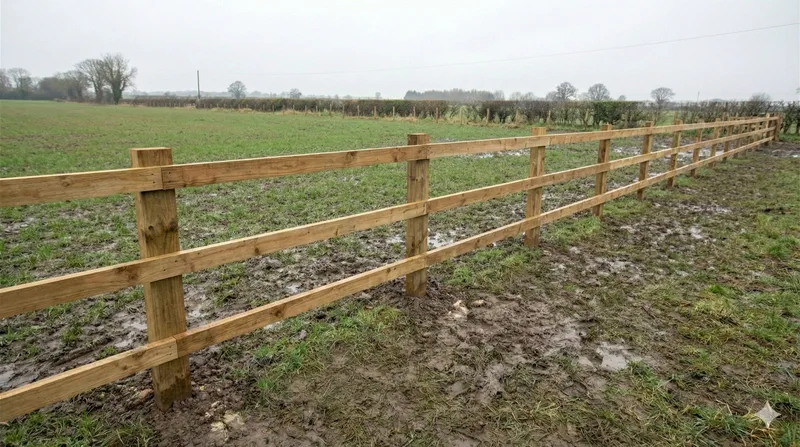
Expert Heavy-Duty Post & Rail Fencing Services
Post and rail fencing is the workhorse of rural and equestrian boundaries. We install heavy-duty post and rail systems for paddocks, smallholdings, agricultural land, and commercial perimeters across Nottingham and Nottinghamshire — built with larger-section timber, deeper-set concrete-fixed posts, and the kind of joinery that stands up to livestock, weather, and time.
Whether you need to contain horses, mark a working agricultural boundary, perimeter a commercial yard, or define a large rural plot without losing sight lines, post and rail is often the right answer. The detail is in the spec — and that's where heavy-duty differs from economy.
Why Choose Our Heavy-Duty Post & Rail Fencing?
Quality Materials
Premium timber and materials built to last
Expert Installation
Skilled craftsmen with years of experience
Competitive Pricing
Fair quotes with no hidden costs
Guaranteed Work
Full warranty on all installations
When to specify post and rail fencing
Post and rail isn't a fence-everything solution — but where it fits, nothing else looks or performs the same. We install regularly for: equestrian properties (horse paddocks, livery yards, manège surrounds, hacking perimeters), smallholdings and farms (sheep, cattle, alpaca containment), large rural gardens with field-style boundaries, commercial premises needing a clear-sight perimeter (industrial estates, car parks, leisure facilities, country pubs), and as feature fencing on driveways and entrances where a closed panel would block aspect.
What makes our spec heavy-duty
Three things separate heavy-duty post and rail from the cheap stuff homeowners regret. First, post section — we use 100×100mm or 125×125mm posts on our heavy-duty installs, not the 75×75mm you'll find on economy lines. Second, depth and fixing — every post is set 600–750mm into the ground in a haunch of post-mix concrete, not punched in dry. Third, rail dimension — our heavy-duty rails are 87×38mm minimum (some configurations use 100×38mm or 100×50mm), pressure-treated to UC4 grade, fitted with galvanised through-bolts or substantial coach screws rather than nails. The result is a fence line that survives livestock pushing, leaning, and the long Nottinghamshire winters.
2-rail, 3-rail, 4-rail: picking the right configuration
Rail count comes down to what you're containing and how the fence is read from a distance. 2-rail is decorative — driveways, formal manège surrounds, dressage arena perimeters, gardens. It's not livestock-spec. 3-rail is the standard equestrian and smallholding choice — adequate for most horses and ponies, sheep, alpacas; the most-installed configuration we do. 4-rail is heavy-containment work — cattle, deer, perimeter where animals push (yearlings, weanlings), or commercial sites where the fence doubles as a security signal. We're happy to mix configurations across a single site (4-rail along a road, 3-rail on quieter aspects) where it makes sense.
Heights, post spacing and detailing
Standard equestrian post and rail runs 1.2–1.4m above ground for most horse work, with posts at 1.8–2.4m centres. Cattle work calls for taller posts and tighter spacing. End posts and corner posts are stepped up — 125×125mm with diagonal struts for tension — and gateposts come 150×150mm or larger, set deeper, with internal bracing if the gate is field-width. We integrate field gates, pedestrian access, and bridle gates as part of the run rather than as bolt-on afterthoughts.
Materials and treatment
Pressure-treated softwood (UC4 grade) is the default — kiln-dried, vacuum-pressure impregnated with copper-based preservative, suitable for in-ground contact and the working life expected from agricultural fencing. We can quote in oak, sweet chestnut, or hardwood post-and-softwood-rail combinations for clients who want longer-lasting or more traditional looks. All metalwork (through-bolts, post caps, brackets) is hot-dipped galvanised. We don't use bright-zinc fixings on heavy-duty installs — they don't last.
How we install
Site visit and measure first — we mark out the run, identify gate positions, flag any service crossings or boundary disputes, and confirm ground conditions. On install day we set posts in concrete (mechanical augering on most jobs; hand-dug on awkward access), wait long enough for the concrete to take, then run the rails. Heavy-duty rails are bolted not nailed. We strap up at corners and braced posts. Site cleared and waste removed at the end. Most paddock-size jobs run 1–3 days; longer commercial perimeters quoted bespoke.
Where we work in Nottinghamshire
Most of our post and rail work falls inside a 20-mile radius of our Colwick yard — covering Nottingham, West Bridgford, Burton Joyce, Calverton, Bingham, Cotgrave, East Leake, and the rural belt around them. Notts soil is a mix of Mercia mudstone, Sherwood sandstone, and clay — drainage and post-setting both depend on getting the right concrete mix and depth for the ground. We've installed in shifting clay near the Trent floodplain and in compacted sandy sub-soil up towards Mansfield; the spec adjusts but the principle stays the same: deeper, wider, better-fixed.
Why landowners across Nottinghamshire choose K.A.B
We're a Nottingham-registered limited company trading from Chris Allsop Industrial Park in Colwick, with over 140 five-star reviews on Google. Owner-led — Kye runs every job from quote through install, so the person quoting you is the same person directing the team that turns up. Free no-obligation quotes, fixed prices, all work guaranteed. We don't take on more than we can finish properly, which is why we ask you to ring rather than chat — most jobs are best understood with a 5-minute conversation.
Cost and lead time
Cost depends on run length, rail count, ground conditions, gate count, and material choice — but as a rough guide, paddock-size jobs (50–150m) typically come in under what most clients expect for a properly-installed heavy-duty system, and we'll quote line-by-line so you can see what you're paying for. Lead time for survey is usually under a week; install slots run 2–4 weeks out depending on season (spring is busiest).
Request a Quote
Get a free, no-obligation quote for your heavy-duty post & rail fencing project.
Get Quote Call NowAreas We Cover
View All Areas →Frequently asked questions
What's the difference between standard and heavy-duty post and rail fencing?
How deep are the posts set?
Which rail configuration do I need for horses?
Do you use treated timber?
Can you install on sloped or wet ground?
How long does heavy-duty post and rail last?
Do you install gates as part of the run?
How quickly can you start?
Related Fencing Services

Heavy-Duty Feather Edge Fencing
Heavy-duty feather edge fencing in Nottingham — bespoke panel construction, kiln-dried treated boards, traditional looks that age beautifully. Free quote.
Learn More
Heavy-Duty Closeboard Fencing
Heavy-duty closeboard fencing across Nottinghamshire — concrete posts, gravel boards, feather-edge panels. Built to outlast timber-post fences. Free quote.
Learn More
Composite Fencing Installation
Composite fencing in Nottingham — rot-free, low-maintenance panels in stone grey, charcoal, and natural wood finishes. Free quotes.
Learn MoreReady to Start Your Project?
Contact us today for a free consultation and quote. We serve Nottingham and all surrounding areas.